

It Was the World’s Largest Strategic Communications Campaign.
On 19 July 2026, at MetLife Stadium in New Jersey, the final whistle marked Spain’s 1–0 victory over Argentina, securing them the FIFA World Cup title. Worldwide celebrations followed. Headlines hailed Spain’s win, analysts analyzed tactical choices, and millions of fans reminisced about the defining moments of the tournament.
Another story had been developing long before the final whistle.
It was not about goals.
It was about communication.
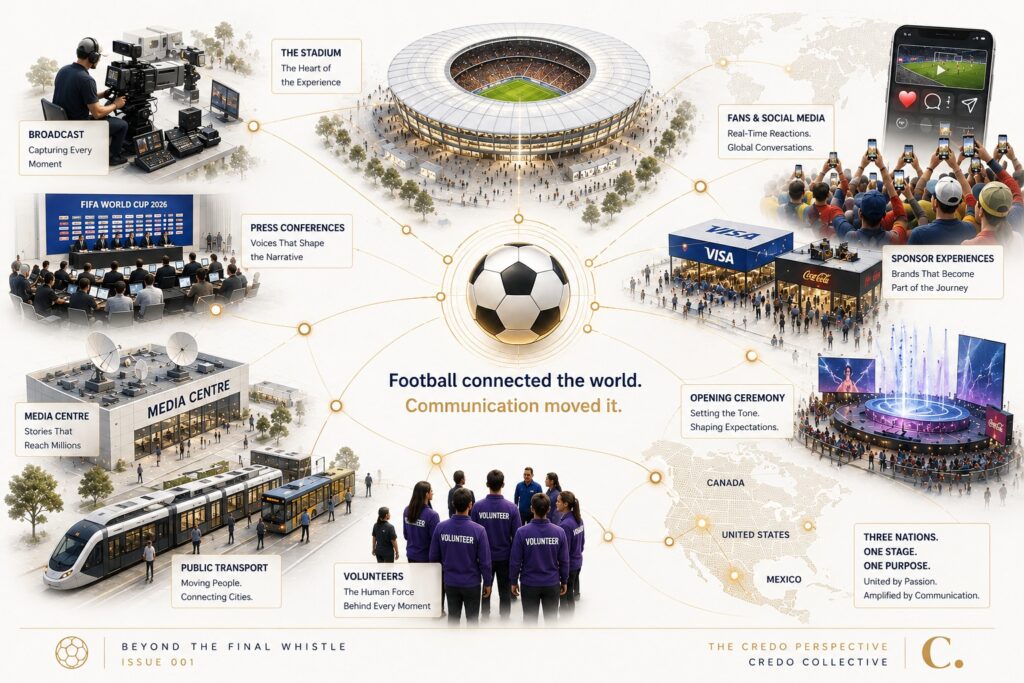
For over a month, the FIFA World Cup dominated discussions across TV, digital platforms, newsrooms, stadiums, and boardrooms. Each host city showcased its unique identity, and pre-match press conferences created headlines before any game was played. Sponsors competed not just for visibility but for emotional connection. Fans turned into content creators, expanding the tournament’s impact beyond the ninety minutes on the field. Even moments of disappointment, controversy, and victory were amplified, interpreted, and shared worldwide in real time.
From a Strategic Communications perspective, the FIFA World Cup has always been about more than just a sporting event.
It ranked among the most advanced live communication campaigns ever designed.
Football connected the world.
Communication moved it.
Watching this year’s tournament, I concentrated not only on the matches but also on the stories around them. While commentators discussed formations, possession, and tactics, I was pondering other questions.
How was the host nation presenting itself to the world?
What made some sponsors remain memorable while others faded into obscurity?
How did leaders communicate amid intense public scrutiny?
What turned a football tournament into a cultural celebration that brings together billions of people from diverse languages, backgrounds, and beliefs?
These questions are not about football.
These are Strategic Communication questions.
And they are important because all types of organizations- startups, multinationals, government bodies, or non-profits- share the same daily challenge: not just capturing attention, but gaining trust.
The FIFA World Cup shows us that extraordinary events are remembered not just for happening, but because they are deliberately communicated.
This is why the tournament serves as a highly valuable case study for founders, communicators, and business leaders.
The Opening Ceremony Wasn’t Entertainment.
It Was the Tournament’s First Strategic Communication Campaign.
Before the tournament’s first match, millions had already shaped their impressions of the FIFA World Cup.
Not because of football.
Because of the opening ceremony.
During the opening ceremonies, audiences experienced the tournament through well-coordinated performances, music, cultural storytelling, visual symbolism, and immersive production. Long before the players took the field, the host nations started showcasing their identity, values, and the atmosphere they wished the world to connect with at the 2026 FIFA World Cup.
At first glance, the opening ceremony seemed like entertainment.
It was not.
It was Strategic Communication.
Every element served a purpose.
The music created an emotional connection.
The visual production strengthened the tournament’s identity.
The cultural performances celebrated diversity across the three host nations and presented the FIFA World Cup as a truly global event. The ceremony set a tone of inclusion, celebration and international unity before a single competitive moment had occurred.
That raises an important question.
What does this mean from a strategic communications perspective?
It shows that communication begins long before the core product or service is experienced.
The opening ceremony was not intended to explain football.
People already understood football.
Its goal was to influence expectations.
To create anticipation.
To establish emotion.
To shape perception before the start of the tournament.
In communication, this is known as strategic framing.
People seldom encounter an event without any context; instead, they interpret it based on prior expectations.
Businesses operate in the same way.
A prospective client forms an opinion before reading your proposal.
A customer begins evaluating your brand before purchasing your product.
A stakeholder forms expectations before attending your event.
A potential employee decides whether your organization feels credible before submitting an application.
Your website.
Your visual identity.
Your social media presence.
Your event experience.
Your founder’s LinkedIn profile.
Your first email.
These are not related to administrative procedures.
They are your opening ceremony.
Organizations often dedicate significant resources to creating outstanding products but neglect the communication experiences that come before them. However, perception usually starts well before the product’s performance can demonstrate its value.
The FIFA World Cup understands this very well.
Before the football could demonstrate excellence, communication had to establish belief.
That is why the opening ceremony was important.
It didn’t introduce the matches.
It introduced meaning.
Credo Reflection
The opening ceremony served as a reminder that reaches well beyond football.
People usually encounter organizations through their website, social media, event invites, founders’ profiles, or employee conversations, rather than directly through their products or services.
In those initial moments, questions that every audience has are quietly addressed.
Can I trust this organization?
Do they understand who they are?
Will this experience be worth my attention?
The most reputable organizations understand that credibility is built not just during delivery but begins with every interaction that shapes expectations before the actual work begins.
Communication shapes perception.
Credibility determines whether people believe it or not.
Maybe the initial lesson from the FIFA World Cup applies to all founders and organizations.
Before you ask people to believe in what you do,
Consider what message your opening ceremony is already conveying.
The world’s largest live communications campaign took place not in a boardroom, but on the World Cup stage.
For thirty days, the FIFA World Cup was impossible to overlook.
Not because football was played every day.
But communication never stopped.
The matches took just ninety minutes.
The conversations lasted for twenty-four hours.
Before the game started, fans discussed team lineups, examined tactical forecasts, and tracked live training updates. During the match, social media turned into worldwide hubs of debate, with every goal, referee decision, and tactical change prompting immediate responses. Shortly after the final whistle, highlights, interviews, player reactions, and expert commentary kept the conversation alive in homes, workplaces, and on mobile devices across all continents.
The tournament was no longer confined to stadiums.
It existed wherever people communicated.
That raises an important question.
What does this mean from a Strategic Communications perspective?
It means the FIFA World Cup is no longer merely an event.
It is an integrated communications ecosystem.
Football is just one part of the experience.
Communication is what turns it into a global phenomenon.
During the 2026 tournament, FIFA, host cities, broadcasters, sponsors, national teams, players, media organizations, and millions of supporters all took on the role of communicators. Together, they built a narrative that extended to audiences well beyond those present at the matches.
Consider the role of digital platforms.
A spectacular goal was no longer experienced once inside the stadium.
The original moment was quickly turned into short videos, circulated on social media, examined by ex-players, talked about on podcasts, recreated by fans, and highlighted by international news outlets. Each platform helped prolong its visibility.
Communication became multiplication.
One event generated thousands of conversations.
The same was true away from the pitch.
Host cities hosted fan festivals, cultural events, and public viewing experiences that promoted engagement beyond football. Sponsors developed interactive activations allowing supporters to connect with brands before stadium entry. Broadcasters offered behind-the-scenes footage, exclusive interviews, and human-interest stories to strengthen the connection between audiences and players beyond match days.
None of these activities changed the score on the scoreboard.
But they significantly shaped people’s experience of the tournament.
That difference is important.
Sport drew attention.
Communication is what gave meaning.
A key feature of the 2026 FIFA World Cup was its large scale.
For the first time, Canada, Mexico, and the United States jointly hosted the tournament. Instead of viewing this as a logistical hurdle, organizers highlighted it as a chance to showcase diversity, collaboration, and hospitality in North America. Despite the geographic challenges, the tournament preserved a unified identity through consistent branding, visuals, messaging, and fan experiences across various host cities.
That consistency was deliberate.
It was Strategic Communication.
Every volunteer uniform.
Every directional sign.
Every stadium graphic.
Every digital asset.
Every media backdrop.
Every ceremony.
Each contribution formed a cohesive narrative that audiences could immediately identify as part of a FIFA World Cup.
This is where many organizations unintentionally undermine their credibility.
Marketing speaks one language.
Sales speaks another.
Customer service offers a unique experience.
Leadership communicates something entirely different.
The result is inconsistency.
And inconsistency creates uncertainty.
The FIFA World Cup demonstrates the opposite principle.
Its communication may come from hundreds of organizations and thousands of individuals, yet audiences experience a single coherent event.
That level of alignment is extremely difficult to achieve.
Yet it is precisely what makes the tournament one of the world’s strongest brands.
The lesson for founders and organizations is not to copy football’s playbook.
Communication functions as an integrated system instead of a set of separate activities.
Your website should reinforce your sales team’s promises.
Your events should reflect your brand’s values.
Your social media should sound like your leadership voice.
Your public relations should complement, not contradict, your marketing.
Every touchpoint either reinforces or undermines the story your organization is trying to tell.
That is why communication should never be treated as a department.
It is an organizational capability.
When all interactions consistently mirror the same values, audiences start to trust what they encounter.
And trust is what transforms visibility into credibility.
Credo Reflection
The FIFA World Cup’s status as a highly valuable sporting event is not solely due to football attracting billions of viewers.
It gained worldwide fame because each match was backed by thousands of well-coordinated communication moments before, during, and after the game.
Football gave people a reason to watch.
Communication gave them a reason to remember.
Businesses often separate marketing, public relations, digital communications, branding, and events into distinct functions.
The FIFA World Cup reminds us that audiences never experience it separately.
They experience a single brand.
One story.
One reputation.
The organizations that communicate consistently are not simply easier to recognize.
They are easier to believe in.
Because credibility is rarely built through a single extraordinary campaign.
It is created when all communications, across platforms, interactions, and experiences, convey a consistent story.
That is where sustainable business growth begins.
The Real Lesson Was Never About Football.
It is tempting to view the FIFA World Cup as unique.
An international sporting event with audiences, budgets, and resources that surpass what most organizations can access.
On the surface, that is true.
Few businesses will ever reach billions of people.
Few founders will launch products in front of packed stadiums.
Few organizations manage to coordinate communication across dozens of cities and hundreds of international media outlets.
But scale is not the lesson.
The principle is.
Whether you are running a startup with five staff, expanding consultancy, a multinational corporation, or a public organization, you are all competing in the same arena.
Not for football fans.
For attention.
For trust.
For belief.
Your organization reaches out daily through communication long before anyone interacts with your product or service.
Your website presents your standards.
Your visual identity communicates professionalism, or its absence.
Your LinkedIn posts set expectations before the first meeting.
Your media coverage shapes reputation before a conversation begins.
Your events create experiences that people associate with your brand.
Your customer interactions either reinforce or undermine the promises your marketing has already made.
These are not isolated activities.
They are your communication ecosystem.
The FIFA World Cup shows what can be achieved when all touchpoints align towards a single goal.
The experience feels intentional.
The message is consistent.
The brand seems credible.
However, many organizations inadvertently produce fragmented experiences.
Their advertising claims innovation.
Their customer service delivers frustration.
Their website feels outdated.
Their leadership conveys a different vision to internal teams compared to what they communicate externally.
Their social media follows trends but does not emphasize the organization’s core purpose.
Individually, each inconsistency seems small.
Collectively, they erode trust.
The FIFA World Cup offers a lesson that extends far beyond football.
It reminds us that audiences evaluate organizations based on the overall experience, not just isolated moments.
They judge the consistency of the overall experience.
Credibility is rarely built through a single outstanding campaign.
It is built by countless aligned communication choices that mutually strengthen each other over time.
This is exactly why Strategic Communications should not be seen just as promoting an organization.
It aims to align an organization’s statements, actions, and public perceptions.
When those three align, something remarkable happens.
Communication no longer feels like persuasion.
It begins to become proof.
Looking Beyond the Final Whistle
This article began with a simple observation.
Most people watched the FIFA World Cup through a football lens.
I watched something else.
I watched one of the world’s most sophisticated communication ecosystems unfold in real time.
The opening ceremony set expectations.
The tournament sparked global conversations.
Every interaction reinforced a carefully crafted identity.
Behind every memorable football moment was an equally important communication decision.
That is why this series is titled Beyond the Final Whistle.
Because some of the most valuable lessons from the FIFA World Cup are found long after the match has ended.
Most people saw football.
I saw communication.
That’s the perspective this series will explore.
Because football is the case study.
Communication is the subject.
Credibility is the lesson.
Next Issue: Reputation Is Won Before the Trophy.
The Credo Perspective
The FIFA World Cup reminds us that extraordinary organizations are rarely remembered for what they produce alone.
They are recognized for the consistent communication of their identity, values, and reasons for others to believe in them.
Every ceremony.
Every conversation.
Every headline.
Every digital interaction.
Every experience.
Together, they shape perception.
And perception influences reputation.
Reputation nurtures trust.
Trust creates credibility.
And credibility is what turns visibility into sustainable growth.
At Credo Collective, we believe organizations do not grow simply because they are seen.
They grow because they are believed.
This is why Strategic Communications, Public Relations, Branding, Digital Marketing, and Events should always be considered interconnected disciplines.
Together, they create something far more valuable.
A credible organization.
Because when communication is intentional, experiences become consistent and promises are kept, making credibility a reality rather than just an aspiration.
It becomes a competitive advantage.
Business Growth Through Credibility.
—
Radhiya Seraj
Founder & Strategic Communications Consultant
Credo Collective
Continue the Series
Beyond the Final Whistle — Part Two
Reputation Is Won Before the Trophy
The top teams at the FIFA World Cup did not all have the same reputation. Some were favorites with long histories of success, while others were emerging challengers trying to change their global image. Throughout the tournament, their reputation was continually influenced and reshaped by press conferences, leadership choices, sportsmanship, and resilience.
In the upcoming article, we will examine why reputation is often built well before reaching success, and why, for organizations, credibility is gained through consistent actions long before customers, investors, or stakeholders choose to trust you.