

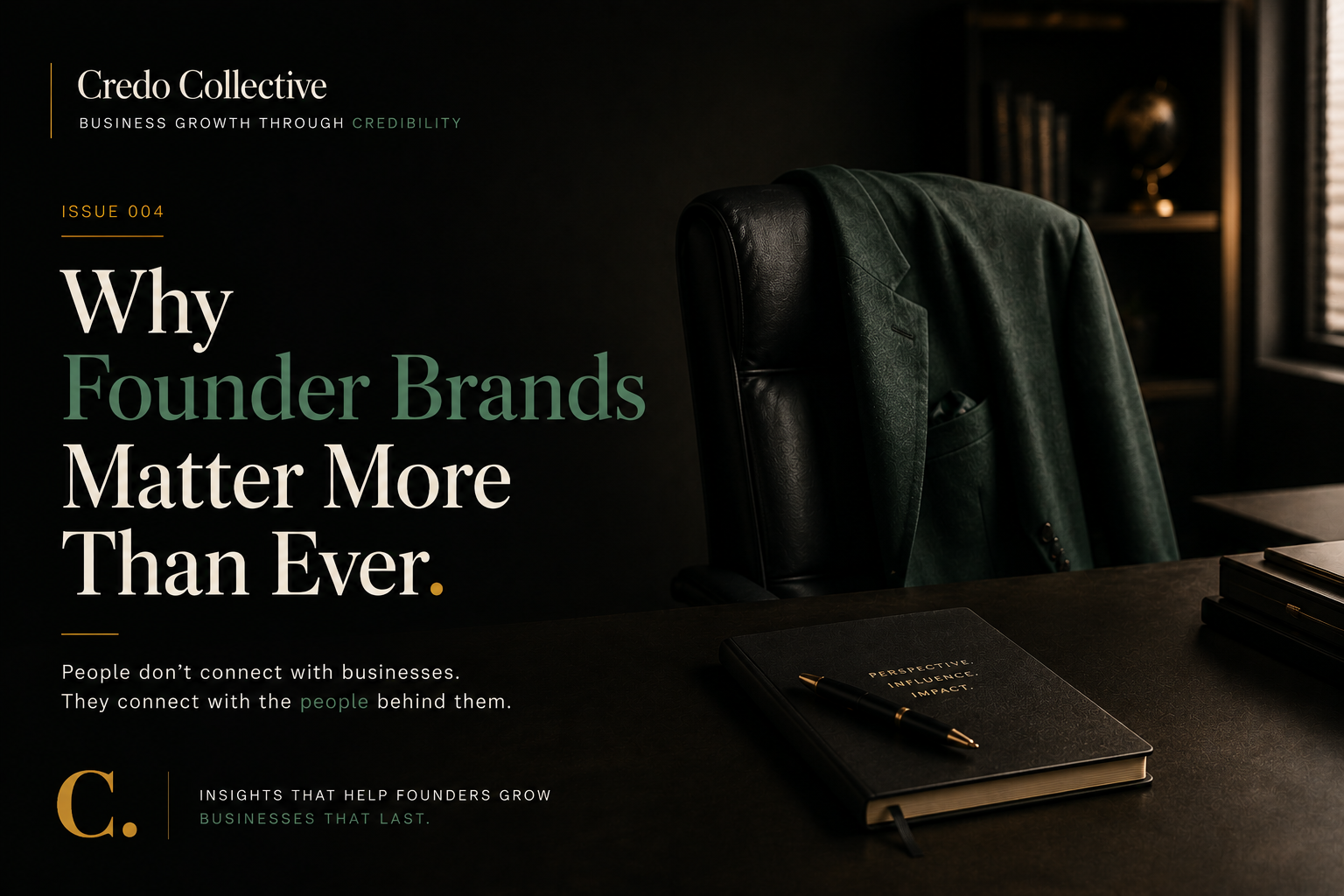

Before They Trust your Business, they often search for your Name.
A generation ago, businesses introduced themselves through brochures, advertisements, and networking events.
Today, that introduction often happens very differently.
Someone hears your company’s name.
Within seconds, they open Google.
Then LinkedIn.
Perhaps your website.
Maybe Instagram.
Sometimes they don’t begin by researching your business at all.
They begin by researching you.
That small shift has quietly changed the way businesses grow.
Increasingly, people are not simply buying products or services.
They are buying confidence in the people behind them.
Business Has Become More Human
Markets have become noisier.
Advertising has become more sophisticated.
Artificial intelligence can generate websites, logos, marketing copy, and social media content within minutes.
Yet as technology has become more capable, people have become increasingly interested in something more human.
Who is behind the business?
Customers want to know who they are buying from.
Investors want confidence in founders.
Journalists want credible voices.
Employees want leaders they can believe in.
Partners want relationships built on trust.
Behind many successful businesses is a person whose reputation strengthens the organization around them.
In an increasingly digital world, business has become deeply personal once again.
A Founder Brand Is Not Personal Branding
One of the biggest misconceptions around founder branding is that it is simply another form of personal promotion.
It is not.
Posting photographs every day does not build a founder brand.
Collecting followers does not build a founder brand.
Speaking louder than everyone else does not build a founder brand.
Those things may increase visibility. But visibility and reputation are not the same thing.
A founder brand is the consistent reputation people form about you when you are not in the room.
It is the ideas you are known for.
The values you consistently demonstrate.
The problems people believe you can solve.
The way you communicate in moments of both success and difficulty.
Your founder brand is not defined by what you claim.
It is shaped by what people repeatedly experience.
Every Business Is Borrowing Trust
When someone encounters a business for the first time, they rarely know enough about the organization to trust it immediately.
So they look for signals that reduce uncertainty.
Sometimes it is a recommendation.
Sometimes it is a client testimonial.
Sometimes it is credible media coverage.
Increasingly, it is the founder.
The reasoning is often simple:
“If I trust the person behind the business, I am more likely to trust the business itself.”
That trust does not happen overnight.
It is earned through consistent communication, thoughtful ideas, demonstrated integrity, and professional credibility.
Over time, the founder’s reputation can become a source of confidence in the organization itself.
In that sense, the business begins by borrowing trust from the person behind it.
Visibility Is No Longer Enough
A founder can have thousands of followers and still struggle to build meaningful trust.
Credibility creates confidence.
There is an important difference.
People may follow you because they enjoy your content.
They choose to work with you because they believe in your expertise, judgment, and reputation.
That is why you should never measure the strength of a founder brand by audience size alone.
A smaller audience that genuinely trusts your expertise can create greater business value than a much larger audience that consumes your content.
Visibility tells us how many people can see you.
Credibility tells us how many have a reason to believe you.
Influence is not measured solely by attention.
It is measured by belief.
Your Ideas Are Part of Your Brand
The strongest founder brands are rarely built on personality alone.
They are built around ideas.
Simon Sinek became known for challenging leaders to think about purpose.
Brené Brown became closely associated with vulnerability and courageous leadership.
James Clear built a reputation around the power of small, consistent habits.
Their visibility certainly matters.
But what makes each of them memorable is not simply who they are.
It is what they have taught people to think about.
That is the real power of a founder brand.
You are not simply remembered as a person.
You become associated with an idea.
And when that idea is relevant to the work your business does, your thinking strengthens the reputation of the business behind it.
For me, that idea is straightforward:
Business Growth Through Credibility.
It is more than a slogan.
It is the philosophy that shapes how I think about public relations, branding, strategic communications, founder positioning, and business growth.
Every article, workshop, conversation, and client engagement begins with that belief.
Founder Brands Create Organizational Credibility
One of the greatest advantages of a strong founder brand is that it can begin building confidence long before a sales conversation takes place.
A thoughtful LinkedIn article.
A podcast interview.
A conference presentation.
A helpful conversation.
A well-written opinion piece.
Individually, these moments may seem small.
Collectively, they shape a reputation.
Over time, that reputation begins working before the founder enters the conversation.
People may already know your name.
They may already understand how you think.
They may already have a sense of what you stand for.
You are no longer starting from zero.
That familiarity reduces uncertainty.
And when uncertainty decreases, trust becomes easier to build.
Becoming Known For Something
One question has shaped much of my thinking:
“When people hear your name, what is the first idea they associate with it?”
The answer should not be everything.
It should be something.
Strong founder brands become easier to remember when they consistently connect to a clear idea, perspective, or area of expertise.
That clarity creates memorability.
Memorability strengthens reputation.
Reputation builds credibility.
And credibility creates opportunity.
Founder brands are not about achieving fame.
They are about becoming known for something that matters.
The Credibility Perspective
At Credo Collective, we believe founder brands are built on contribution, not self-promotion.
Visibility may introduce the founder.
Credibility gives people a reason to trust what that founder represents.
Every useful idea shared.
Every commitment kept.
Every difficult moment handled with integrity.
Every interaction that confirms what people already hoped to believe.
Individually, these moments may seem small.
Together, they shape a reputation.
And when a founder consistently demonstrates credibility, that reputation can strengthen confidence in the organization they lead.
Because in today’s business environment, people don’t evaluate businesses in isolation.
They also evaluate the people behind them.
A founder brand matters because a person’s reputation can become part of the business’s credibility.
Business Growth Through Credibility.
What does your reputation say before you enter the room?
For founder-led businesses, credibility often begins long before the first conversation.
Credo Collective helps founders clarify their positioning, strengthen their public narrative, and build reputations that support the businesses they are growing.
By Radhiya Seraj
Founder & Strategic Communications Lead, Credo Collective
Continue Reading
What Thought Leadership Actually Means
How original ideas create clarity, build credibility, and become part of your reputation.
The Difference Between Reputation and Branding
Why what a business says about itself matters less than what people repeatedly experience.