

The internet has plenty of opinions, but surprisingly few original ideas.
Open LinkedIn on any given day, and you will find thousands of people discussing leadership, branding, marketing, communication, artificial intelligence, business growth, and entrepreneurship.
Many posts are well written.
Many are insightful.
Many sound remarkably similar.
The problem is not a lack of content.
It is a shortage of fresh thinking.
Somewhere along the way, we began confusing visibility with thought leadership. Somewhere along the way, we began confusing visibility with thought leadership.
Readers who have not read Issue 002 can naturally explore that concept. Why Visibility Without Credibility Fails
We started believing that posting frequently, commenting on trends, or sharing motivational quotes automatically makes someone a thought leader.
It doesn’t.
Thought leadership has never been about speaking the loudest.
It has always been about saying something worth remembering.
Influence Begins With an Idea
Throughout history, the people we remember most were not necessarily the most visible.
They were the people who helped us see the world differently.
Simon Sinek challenged businesses to start with “why” rather than “what”.
James Clear reframed success around small, consistent habits instead of dramatic transformation.
Seth Godin encouraged organizations to stop chasing mass appeal and create products so remarkable that people wanted to talk about them.
None of them became influential because they produced more content.
They became influential because they introduced ideas that changed how people understood familiar problems.
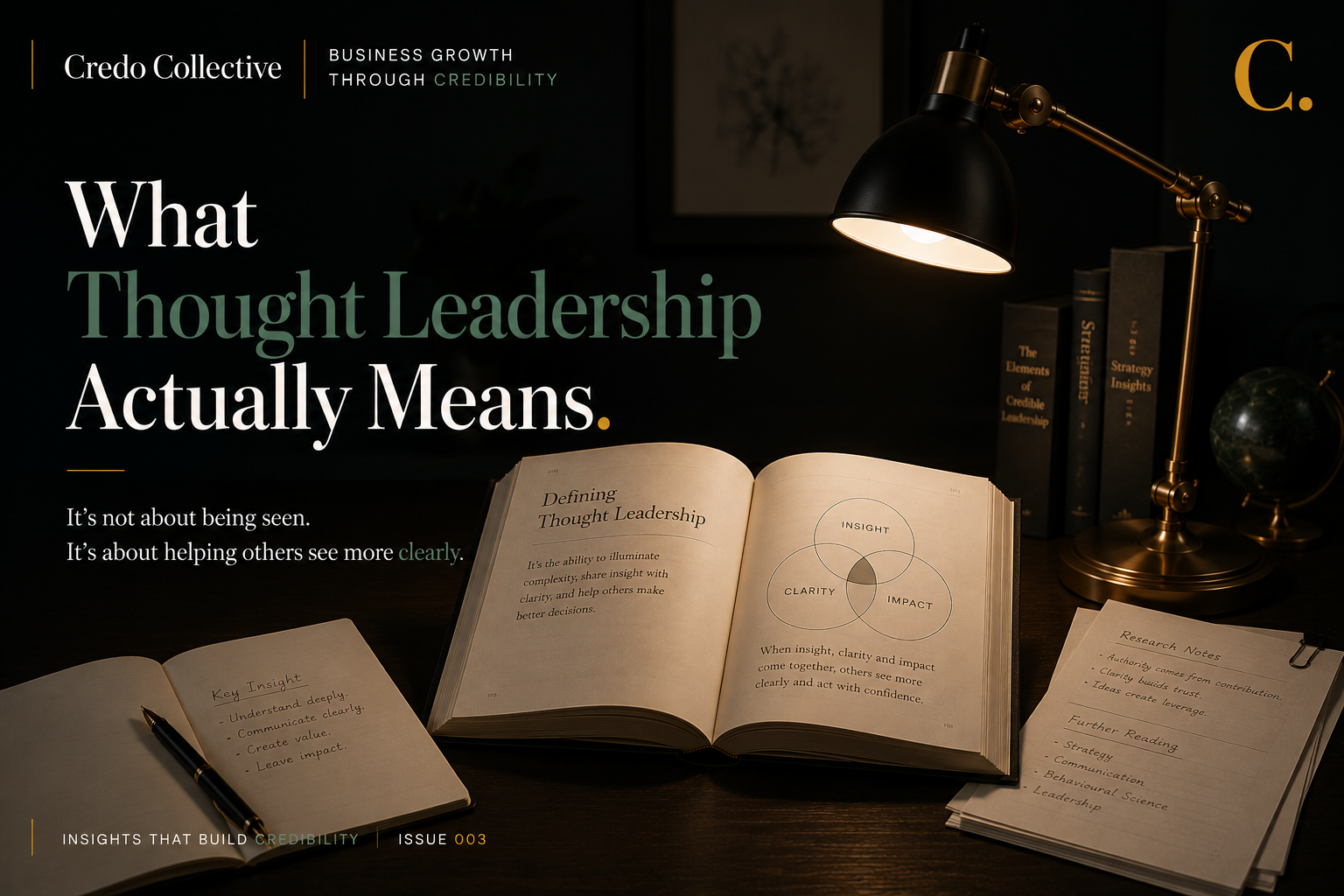
That, in its simplest form, is thought leadership.
It is not measured by the volume of content you produce.
It is measured by the quality of thinking behind it.
Expertise Explains. Thought Leadership Reframes.
There is an important distinction between being knowledgeable and becoming influential.
Experts answer questions.
Thought leaders often ask better ones.
Experts explain existing ideas.
Thought leaders introduce new perspectives.
Experts help people understand.
Thought leaders help people see familiar problems differently.
That distinction matters because businesses rarely become memorable by repeating what everyone already knows.
They become memorable by helping others see something they hadn’t seen before.
That is why I believe thought leadership is not about proving intelligence.
It is about creating clarity.
One thoughtful idea can travel farther than a hundred perfectly designed posts.
The Difference Between Reputation and Branding
The Best Thought Leaders Teach Without Selling
One of the quickest ways to undermine credibility is to disguise every sales message as thought leadership.
People notice.
Audiences have become remarkably good at recognizing the difference between genuine insight and carefully packaged promotion.
The strongest thought leaders rarely begin by asking,
“How can I sell this?”
They begin by asking,
“How can I help someone think differently today?”
Ironically, that generosity often becomes the most effective marketing strategy of all.
When people consistently learn from you, they naturally begin to trust you.
And when trust grows, opportunities usually follow.
Every Founder Has Something Worth Sharing
Many founders hesitate to create content because they believe they have nothing original to share.
I disagree.
Every founder has made decisions others have never had to make.
Solved problems others are still trying to solve.
Learned lessons through failure.
Built relationships that shaped their perspective.
Navigated uncertainty.
Earned wisdom that cannot be found in a textbook.
Those experiences are intellectual assets.
The ideas people value most are often the ones you have stopped noticing because they have become second nature to you.
The challenge is not finding ideas.
It is recognizing that your experience already contains them.
Thought leadership does not require extraordinary stories.
It requires honest reflection and the willingness to share what you have learned.
Readers Can Gain More Insights From These Issues
- Issue 004 – Why Founder Brands Matter More Than Ever – Your experiences shape your founder brand
- Issue 007 – Why Every Startup Needs a Public Narrative – Those experiences become your story
Credibility Is Built One Insight at a Time
People rarely trust someone because of a single brilliant article.
Trust accumulates.
Every helpful post.
Every thoughtful conversation.
Every practical framework.
Every article that leaves someone thinking,
“I’ve never looked at it that way before.”
Those moments quietly build authority.
Over time, your audience begins to associate your name with a particular way of thinking.
That is when credibility begins to compound.
Not because you have become more visible.
Because you have become more valuable.
Your Ideas Become Part of Your Reputation
Increasingly, businesses are remembered not only for what they do.
They are remembered for the ideas they consistently represent.
Apple became associated with simplicity.
Patagonia with environmental responsibility.
Harvard Business Review with rigorous business thinking.
The strongest founder brands work the same way.
Founders who consistently share practical insights often become recognized long before anyone needs their services.
Their ideas open doors before they do.
By the time the opportunity arrives, much of the decision has already been made.
That is one of the greatest advantages of thought leadership.
Your reputation begins working long before you enter the room.
Thought Leadership Is a Long Game
One article will not change your industry.
Neither will one LinkedIn post.
Thought leadership is not built through occasional inspiration.
It is built through consistent contribution.
The people we now recognise as thought leaders did not become influential because of one outstanding article, keynote, or post.
They became influential by spending years helping people think more clearly.
That consistency matters.
Not because algorithms reward it.
Because trust does.
Businesses and founders who consistently contribute valuable ideas become the voices people seek out when important conversations begin.
The Credibility Perspective
At Credo Collective, we believe thought leadership is not about becoming the loudest voice in the room.
It is about becoming the voice people remember long after the conversation has ended.
Visibility may introduce your ideas.
Credibility gives people a reason to believe them.
Every insight you share becomes another opportunity to build trust.
Over time, those ideas shape your reputation, strengthen your authority, and create opportunities long before you need to ask for them.
That is why our philosophy remains simple:
Ideas create clarity.
Clarity builds credibility.
Credibility earns trust.
Trust creates opportunity.
Business Growth Through Credibility.
Continue Reading
If you found this article valuable, you may also enjoy:
- Issue 001: What Is Credibility? — Why people buy certainty, not confidence.
- Issue 002: Why Visibility Without Credibility Fails — Why attention alone doesn’t build trust.
- Issue 004: Why Founder Brands Matter More Than Ever — How founders strengthen organizational credibility.
By Radhiya Seraj
Founder & Strategic Communications Lead, Credo Collective